Risklayer platform
Evidence, not scores — built for the audit, not just the dashboard. Physical climate risk screening for ESRS, CSRD, and VSME workflows.
Self-service data and analytics from the team behind Risklayer's consulting work.
Portfolio screening and ESRS/CSRD/VSME physical risk reporting with full data transparency and documented scenario methodology.
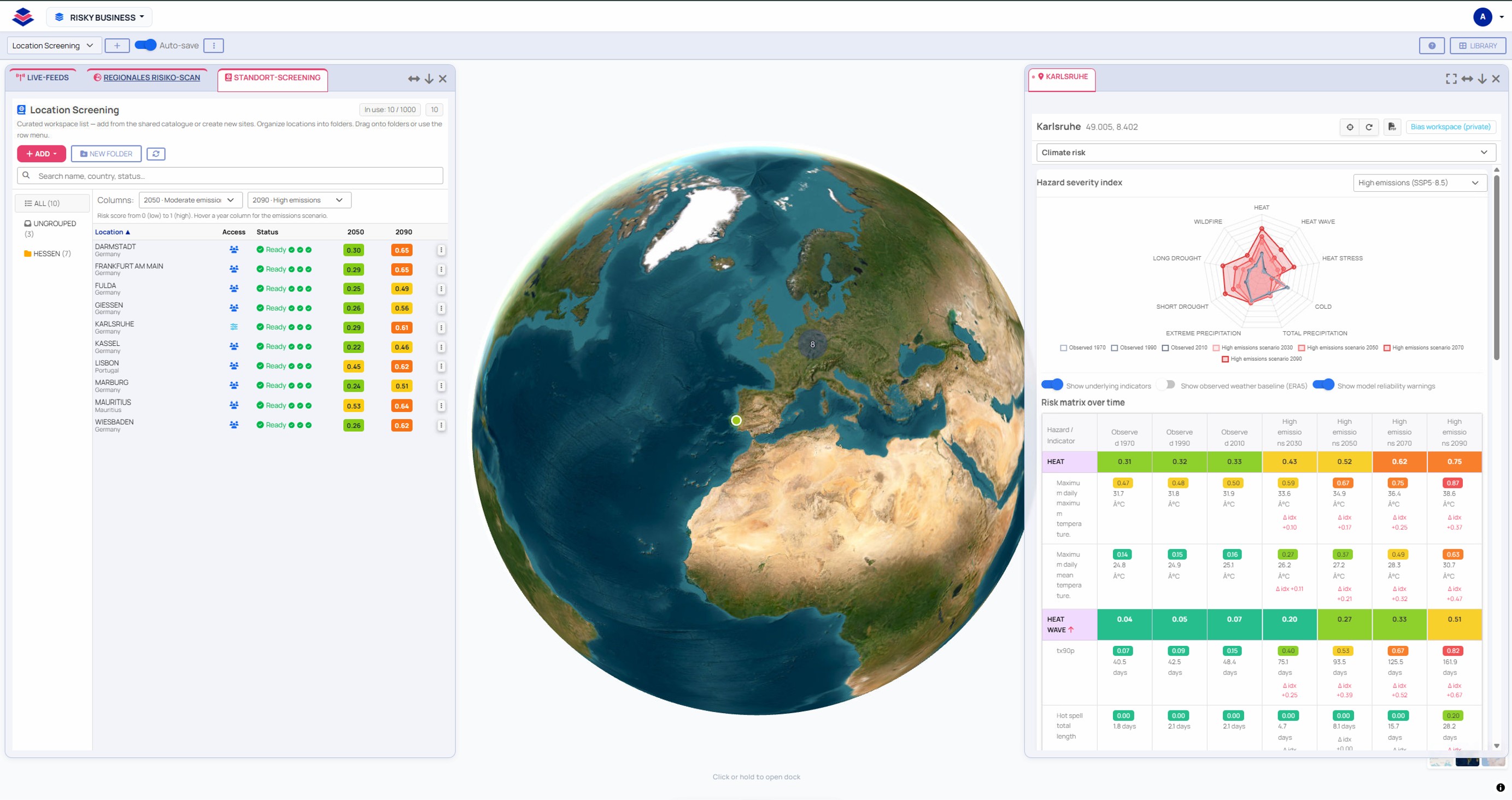
Screening tools output scores. Auditors ask for evidence.
Most climate risk platforms deliver a location score without proving how well the underlying models perform at that coordinate. The Risklayer platform is built to close that gap: every output includes the empirical trail — data sources, model bias, confidence bounds, and the methodological choices behind the numbers.
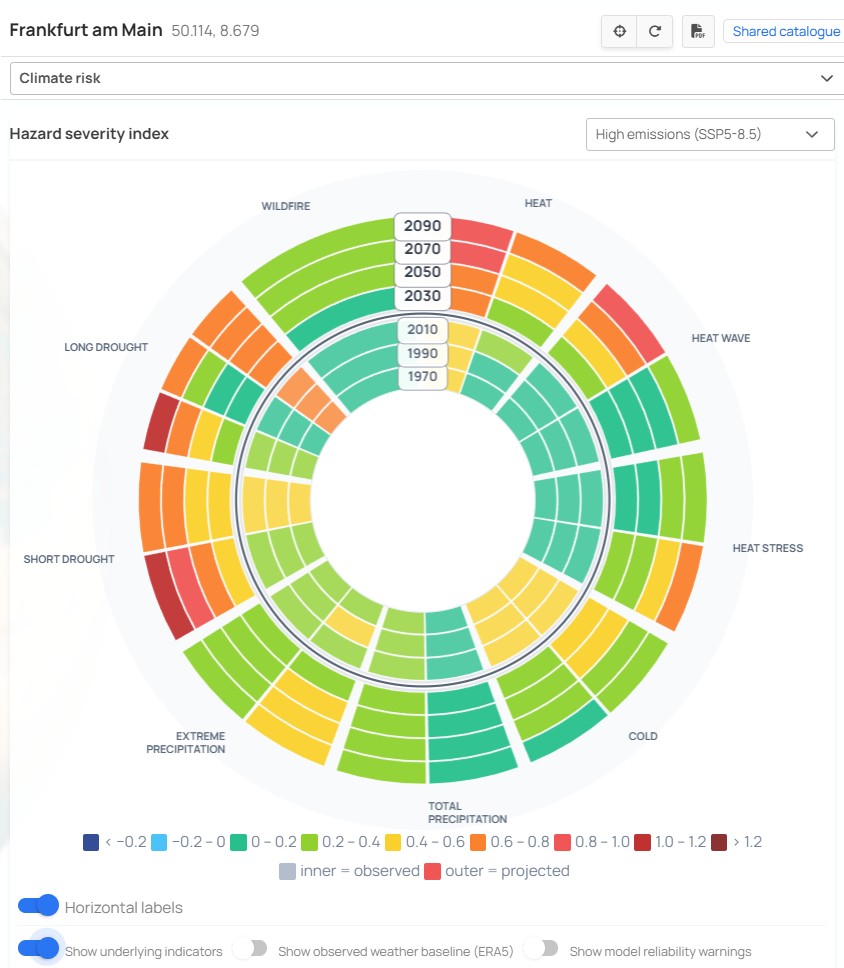
Risk assessments where and how you need it
One underlying risk framework, many regulatory outputs. We have streamlined the process to make it easy to generate the outputs you need, from whole administrative regions down to the building-level. Aggregated and validated on all scales.
- Admin-Level Get a top-down perspective of the challenges in your region vulnerabilities and capacities.
- City-Level: Access global scorecards for your city and its neighborhoods. Physical climate risks, geohazards and more, bias-assessed and documented.
- Asset-Level: High-resolution screening down to the building-level. Urban heat to flash floods, building accurate site assessments and vulnerability profiles. Ready to start mitigation planning.
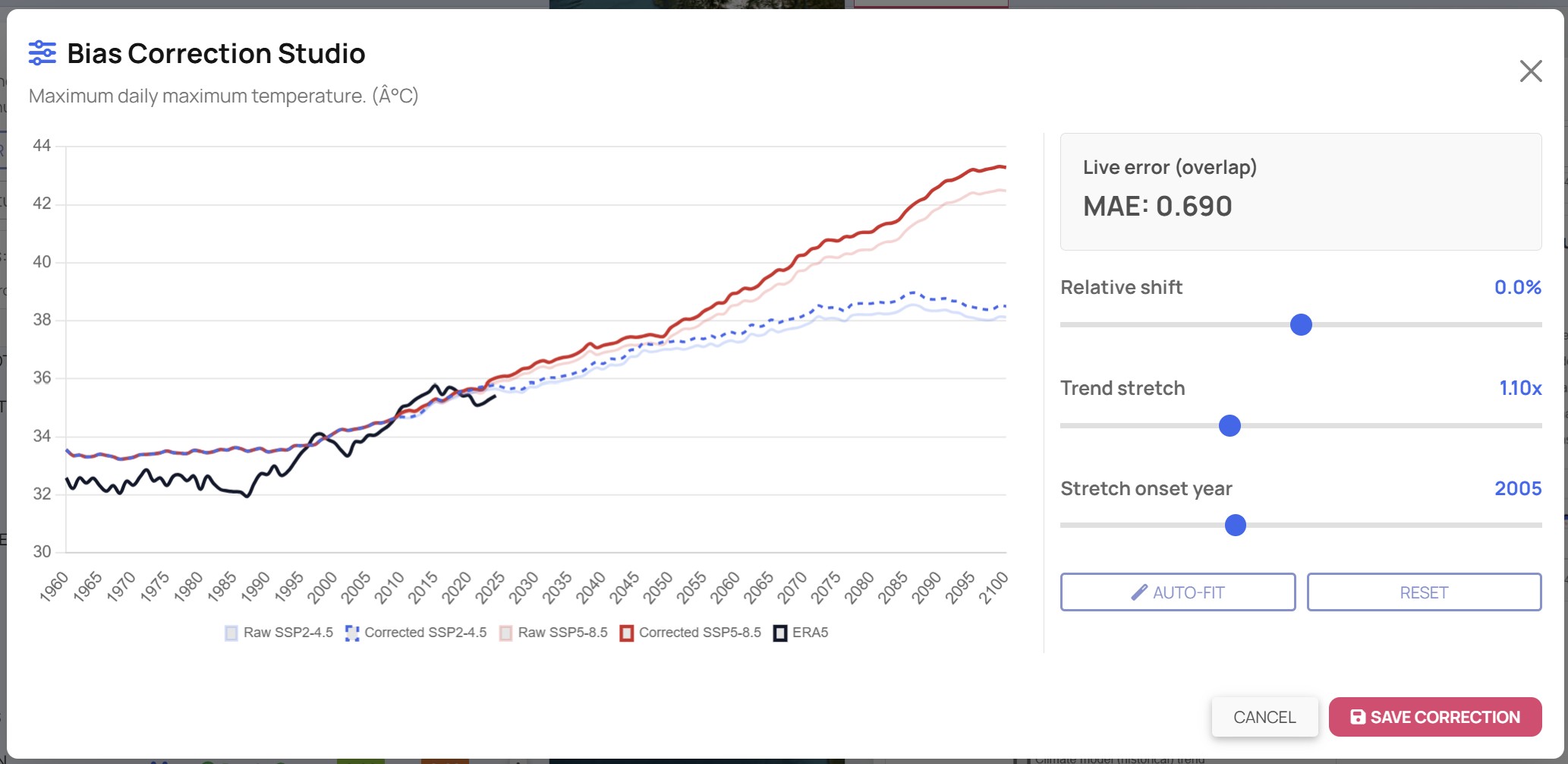
Evidence, not just black-box scores
Auditors don't accept raw scores; they demand methodology. Every location screened in our workspace includes a side-by-side comparison of historical reanalysis against the CMIP6 baseline. The report states model biases and confidence level at that specific coordinate.
- Historical reanalysis (era5 & regional models) as observational anchor
- CMIP6 multi-model ensemble historical baseline and projections (SSP2-4.5 & SSP5-8.5)
- Location-specific bias and confidence documentation (model name, bias, confidence level)
- Proprietary hazard and risk models beyond standard CMIP indicators
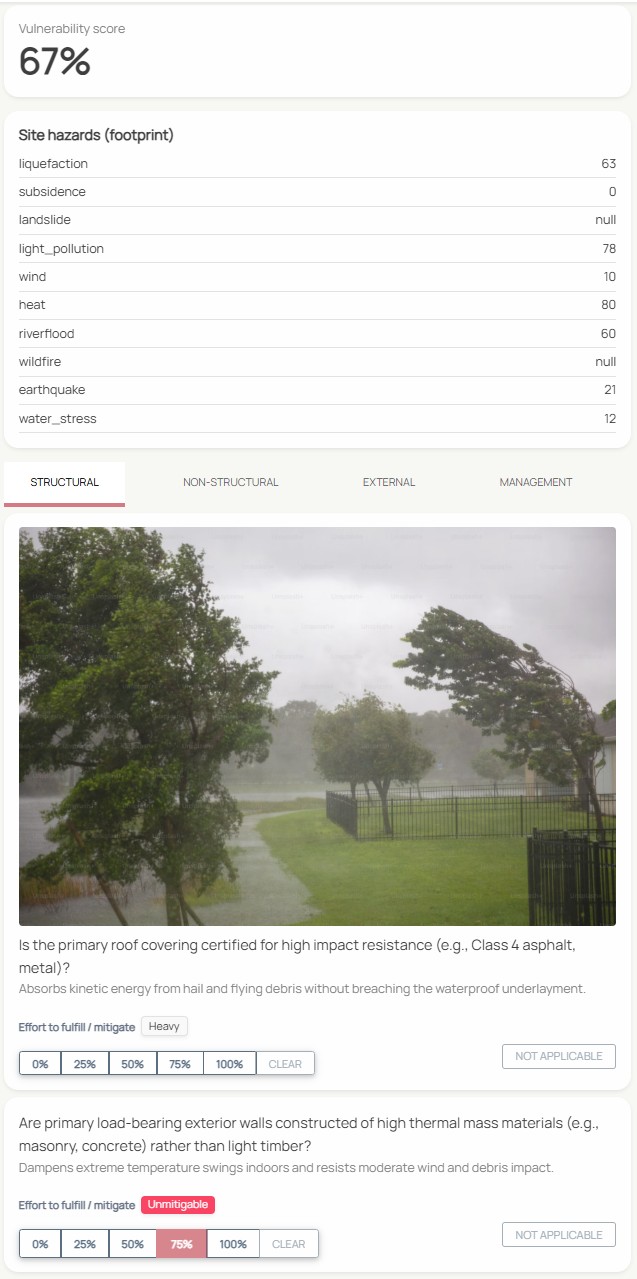
Frictionless Vulnerability Collection
Stop paying for empty seat licenses just to survey your facility managers. Generate secure, no-login links for local engineers or external suppliers to assess vulnerability and capacity data.
Analyse your vulnerability scorings, plan mitigation and resilience strategies across whole portfolios, all in one place. Select from a wide range of vulnerability assessments, designed for residential homes to industrial data centers.
Legacy tools vs. The Risklayer Platform
| Dimension | Typical screening tool | Risklayer platform |
|---|---|---|
| Procurement | Forced €20k+ annual enterprise subscriptions | Transactional "pay-per-report" lane OR collaborative SaaS workspace |
| Risk output | Single black-box score per location | Bias-assessed evidence with reanalysis vs CMIP6 comparison and stated confidence |
| Reporting Format | Generic risk labels that require manual mapping | Choice of literal ESRS taxonomy OR simplified VSME passports |
| Consultant Use | Single-tenant only; messy to manage multiple clients | Agency white-labeling and multi-tenant portfolio management |
What goes in
The Risklayer platform draws on established reanalysis and climate projection datasets. No proprietary black-box models — the methods are documented and the inputs are named.
- Observational baseline
- Global & regional reanalysis datasets — hourly land and atmospheric variables, globally and in detail for e.g. for Germany, Canada, UK, China, etc.
- Climate projections
- CMIP6 multi-model ensemble — downscaled where regional coverage applies
- Hazard layers
- Flood, urban heat, drought, water stress, coastal inundation, wind, tornado, tropical cyclones, earthquakes — multi-peril screening
- Data at the resolution you need
- From aggregated risk scoring at admin level to detailed asset screenings, we can provide data at the resolution you need, where you need it
- Vulnerability Screening
- From residential homes to industrial data centers, we provide vulnerability screenings for your assets or develop them with you to your specific needs.
- Mitigation planning
- Knowing your risks and vulnerabilities is the first step to mitigation. Our platform can help you to plan and scope your mitigation efforts.
Tiers at launch
Pricing announced at launch. Structure below reflects planned capability tiers.
We will provide payment options by volume or flatrate.
Investigator
Pay-Per-Report Transactional Lane
- Single-site checkout (no subscription required)
- Automated hazard baseline
- VSME-compliant PDF generation
- Passkey-protected microsite for asset management
- Secondary share-links for your clients
Professional
Full CSRD / ESRS disclosure workflow
- Upload asset portfolio (CSV / API)
- Automatic ESRS/CSRD/VSME output generation
- Audit-ready methodology appendix
- ESRS-structured output tables
- Vulnerability screening
- Mitigation planning
- Single-user access
Enterprise
Custom integration and volume
- Everything in Professional
- Bulk CSV asset ingestion & data hub
- Custom regional model deployment
- Unlimited frictionless vulnerability survey links
- Dedicated support and SLA
- White-label reporting options
- Multi-user team access
- Portfolio change tracking
Pricing announced at launch
Beyond compliance into strategic resilience
Following our launch, premium workspaces will unlock our Risk Index Builder and Supply Chain Network Mapping. Transition from basic compliance reporting to active adaptation planning by modeling customized mitigation efforts against high-res indicators. Define custom thresholds, adjust vulnerability weights, and design precise climate defense strategies for your supply chain.
Talk to us about the roadmap →Frequently asked questions
Secure your Agency Early Access
The Risklayer platform is accepting applications for founding agency partners. Test, build and develop the platform with us.
Contact our team